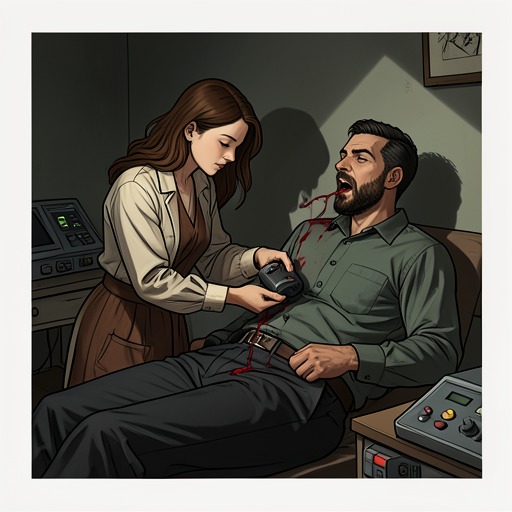
Field Instructions
Black Box (Jennifer Egan Edition)Field Instructions is both a mission log and a guide for others undertaking the same work, stored in a chip beneath the Unnamed narrator’s hairline. Its importance lies in joining the act of carrying out a mission to the act of recording and teaching it: each step can become material for later guidance. Yet the record is not presented as a finished manual. As the mission proceeds, the narrator reflects that the instructions are becoming less and less instructive, exposing a gap between procedural guidance and the experience it is meant to capture.
Storage and Purpose
The chip gives Field Instructions a place within the narrator’s body, rather than in an ordinary notebook or device that must be carried separately. It is meant to preserve two kinds of material at once: the record of a particular mission and lessons that might help future participants. That dual purpose makes it more than a personal diary. The narrator is directed to consider the didactic value of observations and experience, so that what happens to one operative can be rendered useful to others.
The guide’s stated purpose also shapes what counts as a record. The narrator’s experience is not simply to be retained in full; it is to be filtered for what it can teach. The instructions therefore establish a passage from immediate action to reflection, and from reflection to a possible resource for later work. The resulting document belongs to an individual mission but is designed to outlast it as a guide.
Recording and Reviewing Experience
Recording begins through a specific physical gesture: if right-handed, the narrator presses the left thumb against the left middle fingertip. The instructions recommend mentally speaking the thought, as though speaking to oneself, for the clearest results. A bodily action thus initiates a private record, while the prescribed mental form gives that record the shape of articulated speech. The procedure links thought, body, and documentation without requiring an external writing instrument.
The recording is also selective. The narrator is told to interpret observations through their instructional value, and the system permits stray or personal thoughts to be deleted. This combination makes the log neither a complete transcript of consciousness nor an unedited account. It is a curated record, shaped by an expectation that experience should yield lessons while allowing material judged irrelevant to be removed.
That procedure belongs to a larger apparatus of surveillance and communication. The narrator can record a Designated Mate’s conversation through an implanted microphone, send generic pings through the Subcutaneous Pulse System, and operate the Left-eye Camera by pressing the tear duct. The narrator’s whereabouts are also visible to those watching as a dot of light on their screens. These systems gather or transmit information about the mission from the body itself; Field Instructions, by contrast, turn the narrator’s own observations and reflections into a record meant to be reviewed and learned from. Together, they place the operative within overlapping forms of monitoring, communication, and self-documentation.
An Ongoing, Revisable Manual
Field Instructions are explicitly part of an ongoing process of training. Each step is an occasion for learning, but the work of learning does not guarantee that every experience can be converted into a clear rule. The narrator is told that, when the mission is complete, the results of the download may be viewed before the Field Instructions are added to the mission file. The sequence matters: recording comes first, later review follows, and only then may the material be incorporated into the file.
The option to delete personal or stray thoughts makes that later stage consequential. What survives is not automatically identical to what was experienced; the record can be revised before it becomes part of the mission file. In this way, the guide is both accumulated and edited. Its authority rests on experience, but experience must still be selected and organized before it can serve as instruction for someone else.
Form and Narrative Significance
The narrator’s reflections complicate the manual’s promise of clarity. The narrator recognizes both that the instructions are becoming less instructive and that too much reflection is pointless. The two observations pull in opposite directions: the mission requires lessons to be drawn from experience, yet reflection cannot make every moment legible or supply a reliable rule for every circumstance. The guide’s limitations are therefore part of its subject, not a problem the narrative resolves by presenting a complete set of answers.
The story’s form reinforces that tension. In the author’s note, the author explains that the working title was Lessons Learned and that the intended shape would emerge from the lessons the narrator derived at each step, rather than from straightforward narration of the action. The author also connects the story’s atomized structure to the possibility of serialization on Twitter and to the compressed poetry of writing in 140 characters. This account clarifies why Field Instructions matter structurally as well as within the fictional mission: the reader encounters experience in discrete, lesson-like units, while the accumulating sequence reveals how difficult it is to make those units add up to dependable guidance.
The object consequently carries a productive contradiction. It promises that one person’s mission can be recorded for others, and it gives that promise a physical mechanism, a review process, and an editorial principle. At the same time, the narrator’s doubts mark the limits of procedural knowledge. Field Instructions preserve experience, but preservation does not ensure that experience will remain instructive; their form keeps both the effort to teach and the uncertainty of that effort visible.